- Blog
Good Bad Websites: why does my AI website look like everyone else's?
Because AI copies what's already out there and knows nothing about your business. You get the look of an expensive website with nothing inside it. I call that a Good Bad Website.
A mate shows you their new website on their phone. Things fade in, bits slide about as you scroll, there’s a big confident headline over a photo of a smiling team. It looks like it cost ten grand. They tell you it took an afternoon with ChatGPT, and then you read the words and still can’t tell what they actually do.
We’ve entered the era of what I call Good Bad Websites.
What is a Good Bad Website?
There’s a big opportunity right now to make beautiful websites more easily than ever. A few prompts will get you a simple copycat website full of animation effects that would have taken our team two days to build four years ago.
But I’m now seeing loads of fake beautiful websites with no substance. Shite content, AI-generated images and marketing messaging, wrapped up in something that looks expensive.
It’s the website version of those bad AI-generated pub posters (you know the ones). They look good, but they’re too much. And once you’ve noticed one you start seeing them everywhere.
Why do AI websites all look the same?
Because AI has no idea what makes your business different from the next one, so it gives you what every other website has. It doesn’t learn from your taste, it learns from what already exists out there. And websites were already pretty samey before AI came around and started smashing out websites at a rate of knots.
The fonts are generic. The layouts are stale and obvious, usually a big headline over a stock photo of somebody pointing at a laptop. Ask for a website for a plumber and you get the same website as the accountant down the road, with a picture of a tap on it.
I tested this properly earlier this year. I gave Claude Code a flat image of a design I’d made in Figma and it built it pretty much pixel perfect. Very impressive. It never asked me who the website was for, or how the business makes its money, or what made it different.
It built what I told it to and nothing else. That’s fine when the person typing the prompt knows all that stuff. Most people don’t, so they get the average of every website the AI’s ever seen.
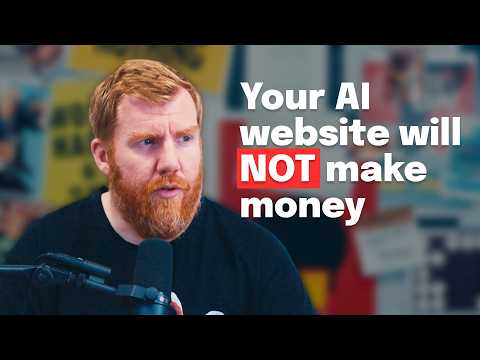 ▶Play the video: 3 things Claude Code will never understand about websites
The words are the worst bit
AI churns out bland, dry, generic copy. It’s the same marketing waffle that was on every website before AI turned up, just more of it, delivered faster.
“We pride ourselves on our hands-on approach.” Everybody’s hands-on. You could pride yourself on your hands-on approach to grave digging and it’d mean exactly as much. Nobody reads it, let alone picks you because of it.
It costs you in Google as well. Google’s spam policies call out websites that lean on AI content to manipulate search results, and they treat it as spam. I had somebody come to me with a website that ranked for 12 keywords when it should have ranked for around 300.
The entire blog was hundreds of AI-generated posts. I went through the rest of that in does AI-generated content hurt SEO?
 ▶Play the video: AI is ruining websites
AI images: the pub poster problem
The images are where a Good Bad Website gives itself away. Everybody’s a bit too shiny and somebody’s got six fingers if you look closely enough. People clock it in a second, and once they’ve clocked one fake thing on your website they stop trusting the rest of it.
Real photos win every time, even ones off a phone. When we rebuilt the website for Glasscraft, we set ourselves one rule at the start: not a single stock photo. We spent days at their factories filming and photographing the actual team and the actual glass coming off the line. Every face on that website works there. The site brings in 60–80 quote requests a month.
Rucklidge Law had the same problem in a different suit. Stock photos that could have belonged to any law firm, on a plain white background. We swapped them for the real team, photographed somewhere warm, alongside rewriting the words so they sound like the people who work there. With the rest of the rebuild, it converts up to 35% better at peak.
An AI image generator can’t do either of those, because it’s never met anybody at Glasscraft. I’ve written more on this in should you use stock photos?, and AI images are stock photos with extra fingers.
All that animation
This is where “the AI can do it in two minutes” gets dangerous. When an animation effect took two days to build, you thought hard about whether it was worth it. Now it costs nothing, so it goes on everything.
I said the same about Webflow last year, and AI’s made it worse. We’re getting the Flash website back. Things that fly in, scroll that doesn’t scroll the way you expect (scrolljacking, my least favourite thing on the internet), menus in odd places. It’s fun the first time, and a pain in the arse the fifth time you come back just to find a phone number.
And yes, I do all that on purpose on this very website. This website is the extreme of all that behaviour, harking back to 90s and early 2000s Flash website design. And I love it.
People come to a business website to find something out and then go and do something about it. Every effect that gets in the way of that is costing you, and it slows the page down too. I’d take clarity over flair every single time, which is why I bang on about why boring websites win more work.
How to tell if you’ve got a Good Bad Website
You don’t need to be technical. Get your website up on your phone and:
- Cover your logo and read the headline. Could it be on a competitor’s website without anybody noticing? Then it’s saying nothing.
- Count the photos of people who actually work for you. If it’s zero, you’ve got a problem whether they came from AI or a stock library.
- Time how long it takes you to find your phone number. More than about five seconds and something’s in the way.
- Ask a customer what they think you do, after they’ve looked at it. This one’s slightly terrifying.
If two or more of those went badly, our do I need a new website? check will tell you how bad it is. And if it was built with AI and it’s started actually breaking, I’ve written up what I find when I open one up.
So should you use AI on your website at all?
Yes, for the right bits. I use Claude Code and ChatGPT every day and so does everybody at Genius Division. It’s brilliant for the typing and the research, and it makes us quicker. I went through what it can and can’t do in can AI build a website for your business?
The words and the photos need to come from you, because they’re the only bits of the website nobody else can copy. Same goes for knowing what the website’s for, which is what we spend most of a web design project doing before anything gets built.
As always, I fall back on this phrase. Just because you can, doesn’t mean you should.
Want us to look at your website?
Send us your website and we'll reply with the first things we'd change. A real person reads it, not a bot.